

Queering Disability / Legislative Advocacy
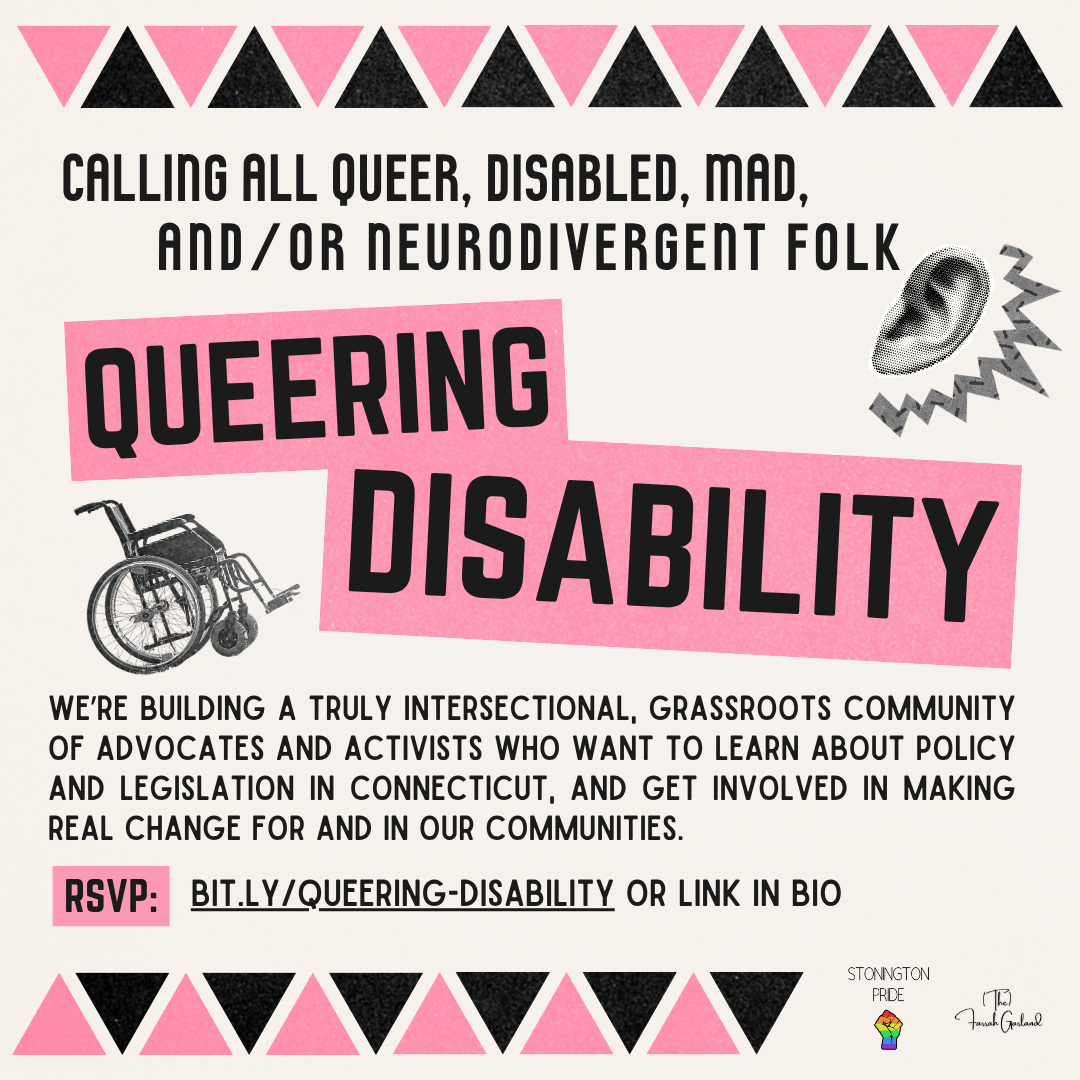

Stonington Pride and (The) Farrah Garland have teamed up to bring you Queering Disability. Originally founded by Farrah Garland and Fern Fairchild of Keep the Promise Coalition, Queering Disability has been through a few transformations. The hardest part is that, being organized by actual disabled (& queer) people, WE ARE SO TIRED, and spread so thin already.
As excited as folks are, taking on one more project is often more than we can do (and life takes us in surprising directions sometimes). So, after a few changes in form (but always staying true to our vision and values), Queering Disability has finally found a home in partnership with Stonington Pride, as our legislative advocacy arm.
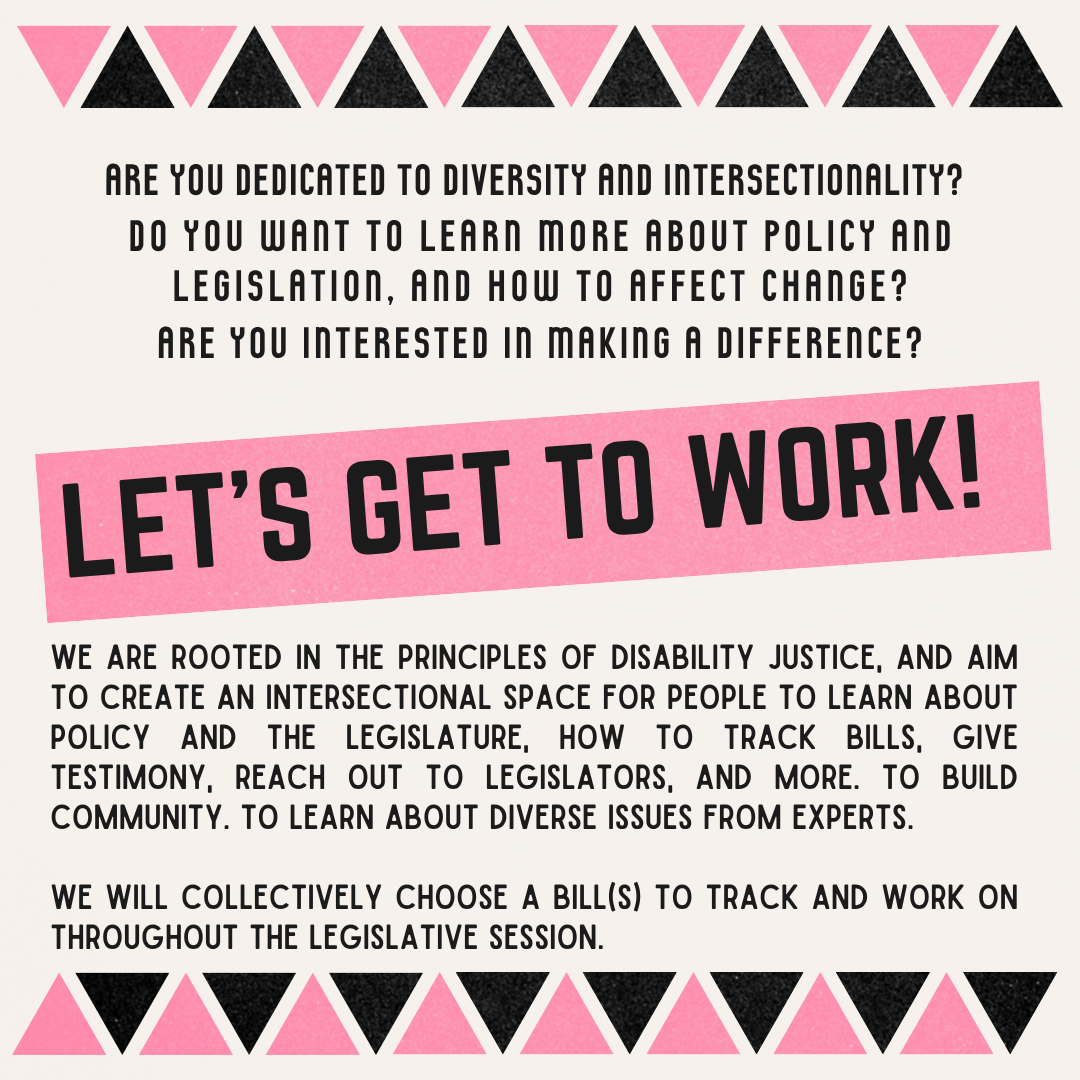
Through Queering Disability, we are building a truly intersectional, grassroots community of advocates and activists, rooted in the principles of disability justice. We’re seeking folks who want to learn about policy and legislation here in Connecticut, and who want to get involved in making change for our communities.
Queering Disability aims to empower and bring together folks who are:
Dedicated to diversity, intersectionality, and disability & queer justice.
Interested in learning about and taking action on policy and legislation that impacts disabled and queer individuals.
Excited about working to affect change in our communities.
Drawn to informative sessions by experts.
Inspired to lift others up as we build power, together.
Current Community Agreements
Take space make space.
Commitment to allowing for course correction - whether it's something we realize ourselves or if someone wants to do that labor of correcting. Allowing for speaking up when you notice someone could be more intentional. Naming the thing.
Learning environment - moving in a spirit of curiosity/good faith judgement
The labor of calling someone in/out - "oops, ouch" - if we don't want to do heavy labor of calling someone in, then we can say "ouch, that hurt", and prompt folks to realize the impact of their actions/behavior/words, etc.
Respectful speech to one another - treating one another with kindness, respect, honoring the space we're sharing with one another and our time together.
Regarding roles - everyone finds their place and does what they can while respecting one another's capacity and our own.
Holding and honoring multiple truths and nuance at the same time; sometimes we're having a shit day and we can recognize how we are showing up caused harm. Anti-carceral attitude/approach to conflict and tension.
Centering access - if we have to stop or things feel clunky just to meet an access need, we're going to prioritize that. Voicing and respecting each other's access needs.
Honoring that sometimes thoughts are a first draft/not a complete thought and that's ok!
Welcoming silence, allowing time for folks to cognitively process and gather.

10 Principles of Disability Justice
INTERSECTIONALITY “We do not live single issue lives” –Audre Lorde. Ableism, coupled with white supremacy, supported by capitalism, underscored by heteropatriarchy, has rendered the vast majority of the world “invalid.”
LEADERSHIP OF THOSE MOST IMPACTED “We are led by those who most know these systems.” –Aurora Levins Morales
ANTI-CAPITALIST POLITIC In an economy that sees land and humans as components of profit, we are anti-capitalist by the nature of having non-conforming body/minds.
COMMITMENT TO CROSS-MOVEMENT ORGANIZING Shifting how social justice movements understand disability and contextualize ableism, disability justice lends itself to politics of alliance.
RECOGNIZING WHOLENESS People have inherent worth outside of commodity relations and capitalist notions of productivity. Each person is full of history and life experience.
SUSTAINABILITY We pace ourselves, individually and collectively, to be sustained long term. Our embodied experiences guide us toward ongoing justice and liberation.
COMMITMENT TO CROSS-DISABILITY SOLIDARITY We honor the insights and participation of all of our community members, knowing that isolation undermines collective liberation.
INTERDEPENDENCE We meet each others’ needs as we build toward liberation, knowing that state solutions inevitably extend into further control over lives.
COLLECTIVE ACCESS As brown, black and queer-bodied disabled people we bring flexibility and creative nuance that go beyond able-bodied/minded normativity, to be in community with each other.
COLLECTIVE LIBERATION No body or mind can be left behind – only moving together can we accomplish the revolution we require.